

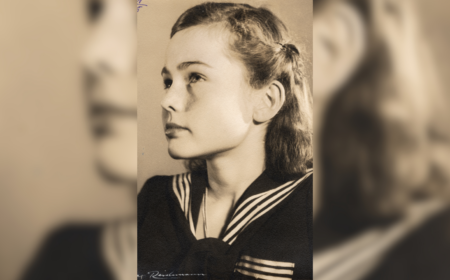

After living in Europe for almost two years, Melissa returned to the US in 1955, going straight to Washington, DC. There she enrolled in Georgetown University’s School of Foreign Service, at the undergraduate level, which was mostly directed at preparing students for diplomatic careers. She had already completed two years at Mount Saint Mary’s College in Los Angeles, so she needed another two years’ worth of credits.
At that time, Georgetown did not accept women for the full-time day school, so she took part-time night classes, paying with money from her father and from what she earned from Elaine Shepard, a journalist, as an au pair, taking care of a young girl. Then she learned that the day school would open for women, but she didn’t have enough money.
Georgetown is a Catholic school run by the Jesuit order. “Father Favner was regent of the school,” recalls Melissa in the ADST oral history website, “I went in to see Father Favner, (…) and I said, “Father, I have very good grades, here they are. I started in January of 1955. Now you’re opening the day school and I need some help and scholarship assistance and I don’t qualify for anything”. The exact words I used were “because I’m not the son of a merchant seaman, I’m not the son of a Latin American diplomat, I’m not the son of whatever. God made me a woman!” He sort of looked at me and I said, “I really, is there some way you could help me because I’ll be going to school here for the next 20 years, it seems.” After about three minutes, I said, “Father, you think there’s a chance you might help me?” Well, I got out of there so fast and I thought, “Well, that’s it.” And then within a very few days I got a very nice letter from him, I still have it, saying that as long as I kept up my what was it, B+ average, whatever it was, I would get 50 per cent scholarship assistance, 50, 75, I think it’s more than that. And then of course I had to pay for my books and so forth. Well, I rushed out and I enrolled in the night school and I enrolled in the day school. The day school didn’t know I was going to the night school, the night school didn’t know I was going to the day school.”
She was the first woman to graduate from the Georgetown School of Foreign Service, and graduated cum laude.

Then she acted on her desire to go to Africa. She applied and received scholarships for a master’s degree in Africa studies at two universities, Northwestern University and Boston University. She chose Northwestern, to study under anthropologist Melville Herskovits, one of the pioneers of African studies at that time. This was before the US State Department had an African Bureau, because most of that continent was still under colonial rule.
“Obviously, that means at that point I was already interested in Africa,” she recalled. “It’s a combination of strange factors, I mean, everything from adventure stories that you hear when you’re young, the films, the movies. As you grow up, you have this sense of exotic almost entirely produced by films and so forth, and you start learning more about it.” One of her favorite movies was King Solomon’s Mines.
Fate, however, would take her on a different route for the time being. She would have to wait twenty years before working in Africa. Instead, she completed a master’s in Latin American studies at Georgetown, paid for in part by the Bolivian Embassy in Washington.
Melissa was invited by Georgetown at least twice to speak there, in 1978 and in 1991, to address the graduating class. As part of the ceremony, the University bestowed her an honorary doctorate. Her advice included these words; “I hope that in your life at this time you have dreams and that you hope to achieve those dreams. I hope that you are taking these dreams seriously and not degrading them with doubts or with an attitude that ‘this too shall pass’. The fact is that a lot of people go through life doing what is safe and not allowing themselves the emotional commitment to a dream. It takes courage – a lot of courage – to keep on renewing your commitment to a dream.”
Her full address may be found here.
In 1994, when working with Sudan issues, one of the graduates from Georgetown approached her and told her how he was inspired by her address. She spoke on a video about this experience.
In October 1997, when she was Consul-General in São Paulo, US President Bill Clinton visited the city, accompanied by Secretary of State Madeleine Albright, who made a point of introducing Melissa to the president. When Melissa mentioned that she had studied at Georgetown, Clinton asked if she had taken classes with Prof. Quigley, Melissa replied, “Yes, and he would read my papers in class as an example of excellent work”.
“He never read any of my papers,” Clinton said. Albright then changed the subject.