

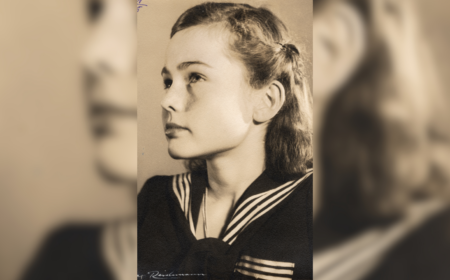

In 1946, Melissa and her mother Miliza Korjus moved from New York to Los Angeles, where her father, Kuno Foelsch, lived. It was during this period that she went through a series of crises and challenges that would have a major impact on her personality.
“At this stage of my life, I was practically obsessed with trying to bring my parents together and have a happy family. I decided that if I went to live with my father in California, my mother would follow me there,” she wrote in a memoir in 2018.
It was during these three months in 1946 that Melissa learned that Lia, the lady who had been her nanny and had emigrated with her parents from Europe in 1936, had been secretly in love with her father for many years. Before the family moved to Mexico in 1941, “Lia was just a wonderful, warm-hearted nanny who took very good care of me while my mother was off becoming a movie star.” Lia stayed in Los Angeles and Kuno spent most of his time there, working at US aircraft manufacturers during World War II.
Once Melissa had returned to Los Angeles and tried to bring her parents together, “Lia became angry at me for trying to bring my parents together.” Melissa wrote in the memoir. The old pattern of angry shouting matches had begun again, this time supplemented with Lia’s tearful shrieks and interventions. “I was absolutely miserable,” she recalled. “My parents decided to go for the divorce.”
The divorce took place in California. In her ADST Oral History, she explained that “In those days if a child was 14 years old it had to appear in court and the judge would ask, ‘Do you want to live with your mother or your father?’ (…) I opted for my father. (…) A traumatic experience.” Her younger brothers, each of whom had a different father, stayed with her mother.
“The finality of the divorce was quite a blow to me,” she recounted in the memoir. Then came another blow: her father lost his well-paying job in 1947 and couldn’t find work anywhere because, unbeknownst to him, he had lost his security clearance to work in the defense industry. She and her father became so poor that they had to sell their furniture.
Her mother did not help because she had used all the money from the sale of the house in Pacific Palisades to purchase her lovely new home – without a mortgage. She also owed back taxes to the government.
“I started school at St. Monica’s in Santa Monica neighborhood,” she explained in the memoir. “I really liked the school very much, but I was very shy and did not have many friends at the beginning. The divorce of my parents was messy and reported in the newspapers. I assumed everybody had read the stories. Of course, at my school, nobody cared!
At school I had no friends. I was smart and got good grades but was very shy. At age 13, I had already reached my full height of 5 feet 10 1/2 inches (1.80 meters). I was taller than everybody – boys, girls, teachers, nuns and priests. And I only weighed 99 pounds (45 kilos) – a walking skeleton. Over the years, growing up beside my glamorous mother, I felt like an ugly duckling. Lump the foregoing with my family problems and it is understandable that I was suffering from a serious inferiority complex.”
“When I was crushed, it was due to my family breaking up and my parents divorcing,” she recounted in her ADST Oral History. “Again, I wouldn’t say it made me feel insecure. If anything, it concentrated my energies in terms of survival and breaking out of a situation which was very difficult, because I loved everyone concerned, but to make a life of my own. At that time, there was some publicity about the divorce in the papers. I was going to a Catholic school, and I felt that everybody knew about it and was looking at me, that sort of thing. Still, I was not going out with boys. I was sort of retarded on that score, generally speaking. I made up for it later.”
She explained that she was also shy. “As a child, and today I still think of myself as shy. Most people collapse when they hear me say I think of myself as a shy person, but I was very shy. I still think I am, because we all carry within ourselves images we have of ourselves originally. Sure, I’ve learned to overcome it, but basically, I’m shy.”
Then a friend made a difference.
“I was saved from further decline by a cheerful and friendly classmate named Barbara Dobrott who reached out to me. Barbara has remained my close friend to this day,” she wrote in the memoir. “I recall that our friendship started when she suggested that because of my height I should join her on the volleyball team. I did so and started playing other sports. I was especially good at swimming, which worked wonders on my body. By the time I graduated, I had added 30 pounds of muscle to my frame. Our swimming team won many meets and brought trophies back to the school.
Barbara and I became real buddies. As teenagers often do, we talked for hours on the phone after school and often she invited me to spend the night at her house. What bliss it was to become, for a brief period, part of a loving, happy family! I treasured every moment of those visits. But through Barbara, I not only went out for sports, but also made lots of other friends and actually became popular – even getting elected to school office. I began to experience self-confidence which I had never known before. (…) Thanks to Barbara’s outreach, the seed had been planted.”
Barbara and Melissa kept their friendship throughout their lives. When Melissa was Ambassador to Estonia fifty years later, Barbara visited her and wrote up a story in the magazine of their college, Mount Saint Mary’s. The two close friends talked for the last time via Facetime a week before Melissa passed away.

For more details on this difficult part of Melissa’s life, please see the ADST Oral History website.
For more information about Miliza Korjus, click here.