

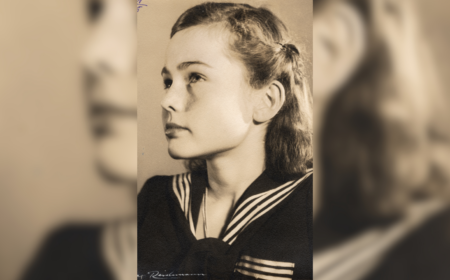

Melissa and her mother, Miliza Korjus, in 1944 moved back from Mexico to the United States, not to Los Angeles but to New York. Her mother performed at prestigious concert halls, such as Carnegie Hall in New York, and did an intense series of tours around the US and Canada, always receiving top reviews for her voice and her beauty. Melissa would accompany her mother on these tours and often would sit next to her mother when she gave interviews to the press, just as they had done when they lived in Mexico. Her father Kuno Foelsch lived in Los Angeles, working at aircraft manufacturers on advanced technologies such as jet propulsion. Their relationship was growing increasingly cold and bitter, and the parents were heading towards divorce. Despite the glamour of her mother’s life, this period for Melissa was a sad one.
She was eleven when she arrived in Manhattan. Her mother enrolled her in a Catholic school two blocks from where they lived on the Upper East Side, St. Jean Baptiste. “You tell them you’re a Catholic,” instructed her mother. Her parents had not included religion or spirituality in her upbringing. The nuns over time noticed that Melissa didn’t have a clue about Christian prayers or Catholic rites. They approached her about this, and she admitted her ignorance with great shame.
In 1945, Melissa had a religious experience in the church of St. Jean Baptiste that changed her life forever. From that moment on, she would say in later years, she got to know God. “I became a Catholic on my own when we moved back from Mexico to New York. It was a very, very deep experience. To say it quite openly, I fell in love with God at a very young age, and that’s been a very strong influence in my life ever since,” Melissa told the ADST Oral History website. To learn more about her religious views, click here.
Meanwhile, Melissa kept touring cities with her mother, who had no idea that in the US education was compulsory. Melissa recounted in her Oral History, “I’d come back to school, and the nuns would say ‘Nice to see you again. Where have you been?’
‘Oh, we went to Cincinnati and then we went to Cleveland and then we took the train all the way over to Vancouver and Victoria,’ [she would say, for example. The local newspapers would include photos of her, including having her birthday in Cleveland.]
Read The Pittsburgh Press talked with Miliza Korjus and Melissa,1944
Read Miliza Korjus and her daughter came out in a Montreal newspaper, 1945

[The nuns] never said anything to me, but I guess somebody from the Board of Education went to see my mother because [one day] I came home from school and she said, ‘We have to have a talk. A woman came to see me today and she said that in the State of New York it was the law that you have to go to school regularly.’
And both of us cried. And she said, ‘If you don’t go to school, they will put me in jail or else I have to pay some heavy fine.’
So that ended my traveling days and I went to school regularly. Now of course, I was a very, very poor student. I was very richly educated in languages and history but then frankly if you’ve been raised on Aztecs and blood sacrifices and things, Pilgrims are a bit boring. And spelling, I couldn’t spell. The arithmetic I had learned in Mexico, they did it differently. I was a very poor student and I got very bad marks and I remember clearly one day, it was in the eighth grade, and I said, ‘I’m fed up with being the dumbest one in the class. I’m going to pay attention, do my homework and get it together.’
It certainly wasn’t my mother motivating me. My father was in California. He was not pleased at the way my education was going. But within a month I was getting very good grades and then all through high school I was an A student.”
In a memoir written in 2018, she looked back on this period: “Looking back as an aging adult, I remember distinctly the will power it took back in New York to practice the discipline to study hard and improve my grades. I just no longer wanted to be the dumbest kid in the class. But that emotional flush of confidence was missing.”
For her tales about New York in 1944-5, click here.
In 1946, Melissa and her mother moved back to Los Angeles.